CANE POINTS: Tempering Expectations On WESM Price Cap
 Consumers have been eagerly waiting for their electric bills this September, expecting (as what they have learned from some news outlets) an approximately 50% reduction in this month’s electric bill.
Perhaps the misreading or confusion over the Energy Regulatory Commission’s order on the Wholesale Electricity Spot Market’s Regional Secondary Price Cap was prompted subconsciously by the desire to give some comfort to consumers who have long suffered rotational brownouts and are also struggling to pay their electric bills.
While it is true there will be a 54% reduction in power rates, the reduction applies only to the power which was purchased from the WESM. For Negros Power, it purchases only 23% of its power requirement from the WESM, and it is only this 23% portion of the total power purchased which will be reduced by 54%.
The 54% reduction applies only to a small portion of the total volume of power purchased by the distribution utility or electric cooperative. The average cost of this total power purchased by the DU or EC is reflected in the electric bill as the Generation Charge. And the Generation Charge forms only a part of the total electric bill. Other charges – like Transmission, Distribution, Taxes and Subsidies – are not covered by the 54% reduction.
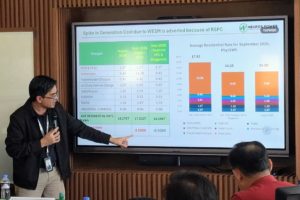
What’s more encouraging is that, for Negros Power consumers, the September average residential rate did not increase; it even slightly decreased by ₱0.03/kWh, compared to the August residential rate.
The relative stability of the August and September rates is due to two factors: this latest ERC price cap on WESM prices, and Negros Power’s move in spreading over five months the collection of the full power / generation charge for this month.
What caused all this confusion? What exactly is this ERC order?
Who could forget the almost daily Manual Load Dropping which consumers experienced in the past several weeks?
These MLDs were caused by the forced outage of numerous power plants, resulting to a shortage of power in the Visayas and Mindanao grids.
 Economics 101: When supply is low and demand is high
The power shortage produced price spikes at the WESM. The ERC noticed that, in some instances during the August – September billing period, WESM prices reached more than ₱25.00/kWh, resulting to average WESM price of ₱18.59/kWh for Visayas and ₱19.56/kWh for Mindanao! This WESM rate is too much for electricity consumers.
Last September 10, the ERC issued an order instituting a regional secondary price cap. The ERC ordered the WESM to recalculate the prices using the regional price cap, resulting to an adjusted average price of ₱8.47/kWh (54% reduction) for Visayas and ₱8.69/kWh (56% reduction) for Mindanao.
If you were wondering why the distribution of electric bills for September was delayed, it was because of this ERC order to implement the regional price cap and recalculate the average WESM price based on the regional price cap.
Negros Power normally distributes electric bills starting at the 16th day of the month. This September, the bill distribution was delayed because it was only last September 21 (Monday) that the WESM was able to send the recalculated reduced average WESM rate. Hence, Negros Power was able to start bill distribution only yesterday (September 22).
Engr. Joe-Mel S. Zaporteza, Negros Power Vice-President and Chief Operating Officer, assured consumers during the presscon yesterday that consumers should not worry about their usual due dates, because this September’s due dates will be adjusted accordingly, corresponding to the number of days that the bill distribution was delayed. If the bill distribution was delayed for six days, the due date will be moved by six days, Engr. Zaporteza emphasized.* (BB)



Comments