Hawaiian Mill Distributes Organic Solutions vs. RSSI
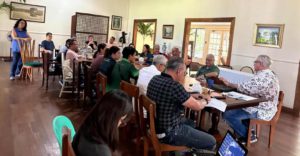
The Hawaiian-Philippine Company (HPCo), one of the country’s pioneering sugar mills led by Chairman Paul Andrew Curran, has intensified efforts to combat the Red Striped Soft Scale Insect (RSSI), a growing threat to sugarcane planters in Negros.
Since early June, HPCo’s technical team has been working on a specific organic solution suited to varying infestation levels. Assisting the team were Yael Skutelsky and Nina Lehmann, international agricultural experts from Israel who imparted their knowledge on biological pest management and visited the island last August 10 to 16 to help refine the treatment procedure, and ensure its accuracy and effectiveness.
Under the guidance of the Israeli experts, HPCO’s team came up with the protocol, which involves a cycle of assessment, spraying and monitoring, designed to gradually reduce RSSI, while supporting beneficial insect populations. The team initially applied the protocol in HPCo’s own cane fields, before extending it to nearby cane farms.
“The use of organic solution in RSSI-affected sugarcane will not kill the beneficial insects present. The organic solution will focus on pest growth disruption and reproduction suppression. Our main goal is to lower the ratio of RSSI to a certain threshold, so that beneficial insects can naturally manage them,” said Rodeo Suating, HPCO’s CoGen Head and Regulatory Compliance Officer, who heads the technical team.
The RSSI primarily targets sugarcane along field perimeters, usually within five meters of the roadside or edges. Infestations lead to yellowing leaves, stunted cane height, and shortened jutes. The insect’s life cycle starts with instar nymph infection, occurring as early as two to three months after cane growth begins, with young and adult scales becoming more noticeable from the fourth to the tenth month.
The protocol starts with an assessment of infestation levels, followed by the first spraying of organic solution, based on the severity of infestation. A second assessment and spraying are then conducted to monitor and reinforce results. Finally, a third round of assessment is conducted to ensure RSSI is reduced to a level, where beneficial insects can naturally keep the pest under control.
HPCo vowed to concentrate on distributing the organic solution to the affected farms. For their part, planters, through their respective associations, will conduct the assessment of infestation levels, and the actual spraying and de-trashing activities in their fields, all while strictly adhering to the protocols established by HPCo.
The organic solution, tested by HPCo’s research and development team, disrupts pest growth, and suppresses reproduction without harming beneficial insects. This approach aims to lower the RSSI population to a level that allows natural predators, such as ladybugs and spiders, lacewings and others, to thrive and provide biological control.
“This is the most affordable option over the use of commercial pesticide, which simultaneously eradicates beneficial insects in the area. Our protocol is available for everyone in our mill district who is affected,” Suating added.
In collaboration with local government units and planters’ associations, HPCo has committed to provide the initial dose of the organic solution free of charge to affected sugarcane farms within its mill district and to its planter members, particularly those in EB Magalona and Silay City, to help the cane farmers effectively manage future infestations.*


Comments