Travel Agencies, Tour Operators Opposing GMO Entry, Too
The snowballing protest against the entry of living genetically modified organisms (GMOs) into Negros Occidental has gained more support, this time from a group of local travel agencies and tour operators.
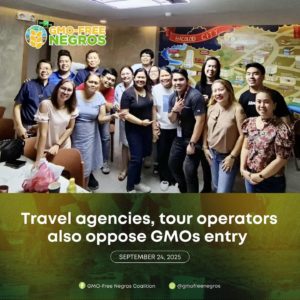
The Negros Island Travel Agencies and Tour Operators Association, Inc. (NITATOA), in a statement dated September 22, 2025, said their group is joining the growing movement opposing the entry and cultivation of living GMOs in Negros Occidental.
“While some sectors believe that GMOs are the solution to the food supply crisis, we point to its documented risks to human health, the critical threat to biodiversity, and the potential harm to our environment,” read the association’s statement signed by their president, Carlos Sto. Tomas.
Other officers are Jaime Luceriano—vice president, Flora Mae Labiang—secretary, Kin Neri—assistant secretary, April Kitagawa—treasurer, Ma. Adoracion Jocson—assistant treasurer, Patricia May Ubas—auditor, and Allan Orpia—public relations officer. Recognized by the Securities and Exchange Commission (SEC), NITATOA works to foster collaboration among its members to promote sustainable and responsible tourism in the region.
The NITATOA backing comes in the wake of the Provincial Capitol’s plan to pass a new regulatory ordinance that would repeal the existing 18-year-old GMO ban in Negros Occidental, as provided for under Provincial Ordinance No. 07, Series of 2007 (The Safeguard Against Living Genetically Modified Organisms). Last week, Negrosanon student leaders and over 50 international organic organizations and also expressed strong solidarity with the GMO-free Negros Coalition in the protest against the entry of living GMOs into the province.
NITATOA, with 14 DOT (Department of Tourism)-accredited agencies for members, added that choosing non-GMO food is not just a trend — it reflects shared responsibility towards health, nature, and the future generations. “We firmly believe that non-GMO food is far better for animal and human health, the preservation of soil and biodiversity, sustainable agriculture, and economic independence.”
The organization said they support local and natural practices to produce our own food, including what we feed our cattle, to have complete control over the quality of food and eliminate the risk of introducing genetically modified materials in the whole food chain.
We want to get the message across that it is possible to feed the Negrosanon people without compromising nature and the health of its people, the association stressed.
Negros Occidental, widely recognized as the “Organic Capital of the Philippines,” has a pioneering legacy in organic farming that dates back to the late 1970s. The dedicated work of Negrosanon farmers has not only earned for the province the title of “Organic Food Bowl of Southeast Asia” but also created a sustainable reputation that is a significant draw for tourism, the group said.
“Every step towards natural production contributes to the fight against climate change and soil degradation. We choose better health, a healthier planet, and a safer future. Because every choice we make today shapes ghe world we will live in tomorrow,” NITATOA also emphasized.* (GMO Free Negros / Go Organic Negros)


Comments