Rjay Pahuganoy: The Incoming Student Who Chooses to Listen
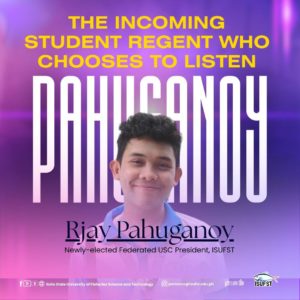 It wasn’t the grandeur of the oath-taking ceremony or the applause that echoed through the halls of ISUFST that marked the true beginning of Rjay Pahuganoy’s journey last May 20 at the Boardroom of ISUFST Main Campus. It was a quiet conviction, long nurtured by experience and a deep sense of purpose, that finally took shape when, in front of his fellow student leaders, he raised his hand and pledged to serve as the newly elected President of the Federated University Student Council (USC) and incoming Student Regent. For 21-year-old Rjay, this wasn’t a coronation. It was a call to action.
Born of humble roots and shaped by the pulse of real student struggles, Rjay’s leadership didn’t bloom overnight. From his early days as a high school organizer to late-night talks with working students juggling classes and jobs, his journey has been defined not by titles, but by moments that mattered. “Leadership isn’t about being above anyone,” the education English major said. “It’s about walking beside them.”
Now holding two of the most significant student roles at ISUFST, Rjay, a consistent dean’s lister, enters this chapter with bold yet grounded priorities. Among them: data-driven institutionalized health breaks and a centralized scholarship platform. “A well-timed break is a necessity, not a luxury,” he insists. And information should never be a barrier to opportunity. These aren’t grand gestures. They’re structural solutions to everyday burdens.
As outgoing secretary of the USC and president of the ISUFST San Enrique Campus Student Council, Rjay knows well that power can mean pressure. Balancing his dual responsibilities is a test of discipline, empathy, and resolve. But he doesn’t walk alone. “My secret?” he smiles. “Purpose and people. I lead with purpose, and I surround myself with people who share the mission.”
His leadership isn’t fueled by ego but by lived truths. “A working student once asked for help with a shifting schedule,” he recalls. “That one plea changed how I saw everything. I realized leadership is about advocacy that echoes beyond words.”
Under the banner “Kawsa sang Estudyante ang Una,” Rjay envisions a USC not just responsive but anticipatory. He outlines a triad of focus areas: wellness, academic equity, and inclusivity. His plan includes a “Campus Voices” initiative to gather grassroots insights, proving that real representation starts by listening.
His seat at the Board of Regents is on the horizon—he is still an incoming Student Regent. But even now, Rjay prepares for this responsibility with humility and resolve. He succeeds Nathalie Jade Tanquerido, and understands the legacy he must honor. “No decision about us without us,” he emphasizes, pledging to amplify the voices of IP students, LGBTQIA+ youth, and those who often remain unseen in formal policy spaces.
Integrity and social justice are the twin flames of his leadership compass. He champions inclusive forms, equity-centered financial education, and student consultations on academic matters. “These aren’t buzzwords. They’re moral obligations,” he affirms.
In a university striving to become a leading research and empowerment hub in Southeast Asia by 2030, Rjay’s advocacy blends seamlessly with ISUFST’s vision. He aligns student activism with institutional goals, bridging student-led green projects and SDG-aligned outreach with the school’s mission for sustainable and inclusive growth.
Behind the regent title-in-waiting is a student who still walks the same paths, eats at the same canteens, and listens to hallway whispers. “My notebook,” he shares, “is full of student stories. Those voices are my agenda.” Perhaps he got this epiphany more clearly after he was sent as one of the representatives of the university in the National Summit of Education Student Leaders in Baguio City last year.
His leadership culture? Co-leadership and critical thinking. “Events are good,” he notes, “but systems change is better.” His USC isn’t a performance troupe. It’s a policy-making, problem-solving body focused on longevity over optics.
Mentors like Instr. Kenth Mark Salcedo and Instr. Jayson Palma helped shape this grounded vision. “They taught me that proximity to people is everything. If you can’t feel their pain, you can’t serve them well.”
His flagship project, “ISUFST Project Pag-Ulikid: Bringing Love and Hope for All,” embodies this ethos. It fuses mangrove planting, community outreach, and mental health awareness. It’s not just a program; it’s a movement of care and continuity.
At his core, Rjay hopes his legacy isn’t built on plaques, but on policies and possibilities. “If one student believes more in their voice because I used mine,” he says, “then I’ve done enough.”
From student halls to policy halls, Rjay Pahuganoy’s journey reflects the future ISUFST strives to build: inclusive, student-led, and driven by purpose. In a world often too loud to hear the youth, here stands a leader who chose to listen. And because he listened, he now speaks—not just for himself, but for all.
Dr. Nordy Siason, Jr., ISUFST President, expressed his admiration for the young leader: “I encourage our student leaders to walk with vision, to speak with wisdom, and to act with integrity. Rjay embodies these values. He leads not only with words, but with his example.”
Dr. Armando Katalbas, Director of the Student Support Center, added with pride, “Rjay reminds us that great leadership is rooted in genuine care. His initiatives reflect what student representation should be—impactful, inclusive, and forward-looking.”
Rjay’s story is still unfolding—but already, it speaks volumes. It is the kind of narrative that doesn’t end when his term does, because the systems he’s beginning to build and the voices he’s amplifying have a momentum of their own. This is student leadership at its most courageous: not loud, but lasting.
To those who may doubt that one student can make a difference, Rjay Pahuganoy answers not with speeches, but with action. And in his quiet, relentless way, he reminds us all that change doesn’t always start with noise. Sometimes, it begins with someone simply choosing to listen.* (Herman Lagon/PAMMCO)



Comments